

Technology evolves rapidly. In this article, we will go through MRP systems, the difference between MRP I, MRP II, and other methods of planning, define companies that use MRP, and decide whether it is necessary to have MRP software for small business. We also introduce the best MRP software based on our research data. Each solution in this list is a powerful example of MRP software for manufacturing, tailored to streamline production and inventory processes. Explore the solutions below to find the one that fits your business. We’re sure you’ll find the right software for your business.
What is an MRP system?
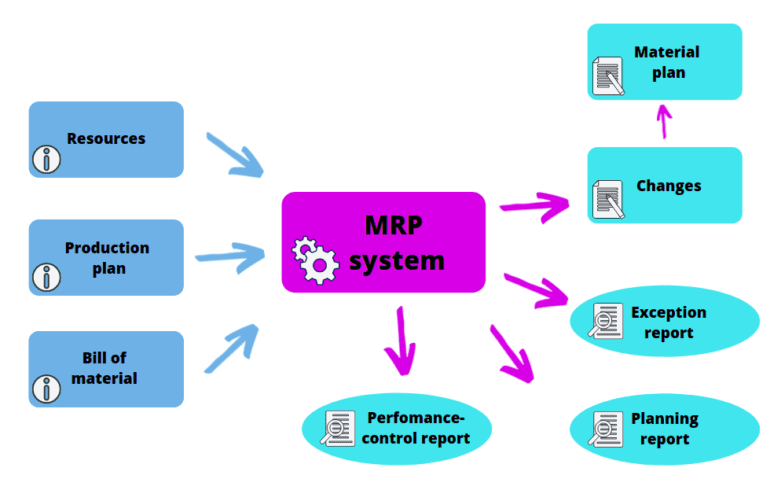
MRP stands for Material Requirements Planning. MRP software automatically translates demand forecasts into precise material requirements, ensuring manufacturers always have the right components available for each production step.
The main purpose of MRP systems is to account for components required for the production of products. The materials which must be in stock at the right time and in the right quantity are monitored via these systems. In many companies, software MRP also acts as a central hub that unifies production data, inventory visibility, and planning workflows.
The major advantage of MRP systems is their ability to track required materials which allows for timely production of units, the implementation of the business plan, and product release. Modern MRP software examples show how companies automate planning, track materials, and optimize inventory in real time.
What are MRP I and MRP II?
MRP systems (or MRP I) are constantly evolving. Initially, MRP systems only simplified the formation of an order plan for a certain period. This approach could not fully satisfy the growing needs. MRP II systems are a further development of MRP systems and are focused on efficient planning of all resources of a manufacturing enterprise.
MRP is Material Requirement Planning while MRP II is Manufacturing Resource Planning. Since the abbreviations are similar and Manufacturing Resource Planning is a modification of Material Requirement Planning, people decided to add Roman numerals to differentiate them.MRP II systems involve the financial component in business planning. There are special tools for monitoring and forecasting a financial plan, budget, money flow. There was an effort to make a “closed loop” in MRP systems to increase efficiency. The idea was to implement a wider range of planning facilities by introducing additional functions related to planning production capacities and material requirements. Additional functions provide analytics of the functions and planning flexibility in relation to external factors such as demand, the state of affairs of suppliers, and so on.
Is ERP the same as MRP II?
InIn recent years, MRP II has integrated with Financial Requirements Planning (FRP) and has evolved into Enterprise Resource Planning (ERP). These business planning systems allow for the efficient planning of all commercial deals, including financial costs, equipment upgrades, and investments in the production of a new product line.
What are the benefits of the MRP solution?
MRP, in both of its configurations, is very handy. It helps:
- Minimize lead time for production
- Optimize inventory storage so that the warehouse doesn’t hold excess materials
- Keep peak production efficiency
- Monitor analytics in different spheres
- Plan budget and required materials
- Answer the question “what if”
MRP software helps a manufacturer identify wasted time and costs, which leads to better workforce utilization, tighter production schedules, and reduced equipment. This is why manufacturers often depend on MRP system software to maintain production stability and eliminate inefficiencies.
These same optimization principles apply to eCommerce for Manufacturers that integrate production and online sales.
Things to Consider When Choosing MRP Software
- Ease of use. Usually, almost every employee in the company uses the MRP system. So, it should be accessible for multiple users from anywhere. That’s why a cloud MRP program is preferred. Also, the interface and functions should be clear and easy to use for non-IT specialists.
- Powerful inventory management and automation tools. MRP is all about inventory management and production planning. To track finished products and raw material effectively, the MRP software should have such functions as low inventory notifications, stock planning, live inventory adjustments, multiple locations for parts, priority-based production planning, manufacturing operations statuses, and other automation functions. The ability to manage manufacturing operations at multiple locations would be a great advantage, too.
- Integrations and API. An MRP system should have integrations with popular eCommerce platforms, including Self-Hosted eCommerce platforms, and accounting software out of the box. Plus, it should offer a flexible API to allow for customizations.
Which types of companies use MRP systems?
It is difficult to form a list of companies using MRP but there are types of companies who should use them. These solutions are especially useful for companies that produce finished goods from raw materials. So let’s look through the production types of the companies.
- Custom production—this type is characterized by a wide variety of products and single-piece production. There are usually a wide range of different equipment, flexible automated production, and wide-profile specialists. They produce complex custom-made items such as planes, watercrafts, and different kinds of equipment.
- Production measured by scale:
- Low-scale production
- Middle-scale production
- Large-scale production
The number of product types is lower than in custom production. They can produce electronics, furniture, small watercrafts, and helicopters.
- Mass production—there are specialized equipment, production lines and technological complexes. They produce a small variety of products at very high volumes. It can be cars, personal computers and various narrow industries such as textile, food, woodworking and so on.
MRP II is fine for all these three types of production. But the choice fully depends on the specificity of the business, since for some types of production there are simpler ways of planning and for others there are more complicated ones.
For the first type of production different types of systems are available: the critical path method (CPM), program evaluation review technique (PERT), as well as MRP II.
For the second type of production MRP II is preferable and there are practically no other alternatives.
For some industries of third type MRP II may be too simple. Here are two other popular systems to these industries: Just-in-time (JIT) and Kanban. However, the last two methods are applicable only when production and sale activity are equally stable. In other cases the only way of planning is MRP II.
No matter whether you only manufacture goods or both manufacture and sell through a B2B multi vendor marketplace, you do need an MPR solution for your business. It will greatly reduce costs and maximize efficiency in the long term.
MRP systems for small businesses
When we were looking through the issue of what companies use MRP systems we examined the example of big industries and their types. But there was no word about small businesses. Does it mean that there is no need for MRP for small businesses at all? Partially, yes, MRP systems are most commonly used by medium and large manufacturers.
However, this does not mean that there is no solution for others. MRP solution is required when you need to automate processes. In some cases, integrating MRP with services provided by the best fulfillment companies can further streamline logistics and reduce operational costs. There are many automation systems which may become a better decision than an MRP system for small business. They are:
- Customer relationship management system (CRM)
- Automated accounting system
- Automated storage and retrieval system
Read about automotive systems for small businesses. The next blocks are for businesses which refers to big industries. We will go through the best MRP software which helps to boost your business even more!
1. MRPeasy
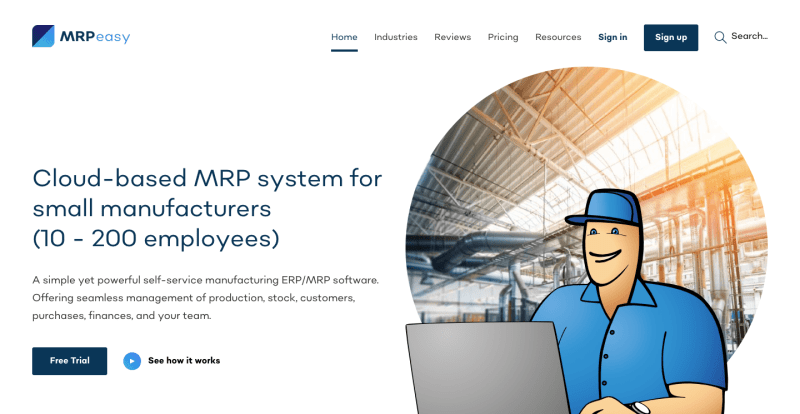
MRPeasy is a cloud-based MRP system for small manufacturers (from 10 to 200 employees). This is a hybrid ERP/MRP software, which means it has additional features that can be useful for resource planning tasks. If you’re looking for a robust ERP software, this could be a good choice.

This MRP software is cloud-based, which means it is easy to deploy and connect multiple users to the system. The interface is minimalistic with drag-and-drop functionality. It is not difficult to understand the system and in our opinion, the system has a short learning curve. Overall, MRPeasy is easy to use as most of the modern MRP solutions. This platform works especially well for manufacturers with limited internal IT resources, because it offers predictable onboarding and a structured interface that does not require technical customization.
The features are rich: production planning and reporting tools, real-time inventory management, costs and lead time estimation, seamless communication between departments, sales and order management, procurement, and accounting. This is one of the most feature-rich MRP programs on our list.
MRPeasy is integrated with QuickBooks and Xero accounting software. Also, it works with eCommerce platforms such as Shopify and Magento. PipeDrive CRM is also supported. This MRP program offers API integrations but only on the Unlimited plan.
Rating on Capterra: 4.5 out of 5
2. Katana
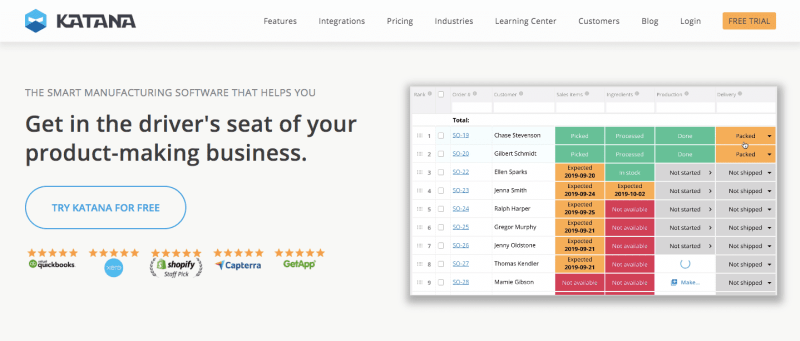
Katana is a cloud-based MRP system with seamless integration with Xero, Quickbooks, Shopify, and WooCommerce. It’s intended for small and medium-sized companies.
Katana MRP is extremely easy to use and you don’t need to be tech-savvy to master the program’s interface and functionality. They offer a detailed video tutorial that teaches you to use Katana in 5 minutes. The implementation time takes on average less than 7 days, which is really fast—most of the traditional ERP/MRP software take months to implement.
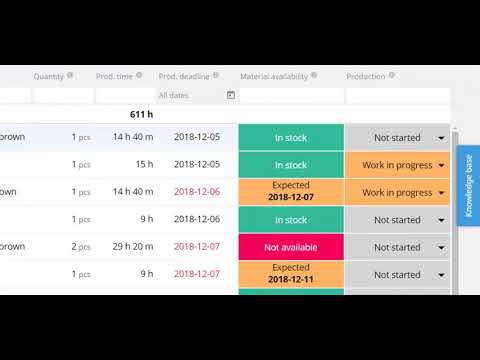
The solution is pretty feature-rich. It has all the functions mentioned on the list at the beginning of the article, plus some more: flexible production control including real-time production status overview, sales order fulfillment tools, materials purchasing automation, and more. Katana MRP gives you all the tools to automate and optimize your production process. One of Katana’s strongest advantages is its visual production timeline, which allows teams to immediately see bottlenecks and reallocate resources without digging into complex reports.
Katana MRP is natively integrated with popular accounting software such as Xero and QuickBooks, and eCommerce platforms—Shopify and Woocommerce.
This MRP script is one of few developed for eCommerce as well as for manufacturers.
Rating on Capterra: 4.7 out of 5
3. ERPAG
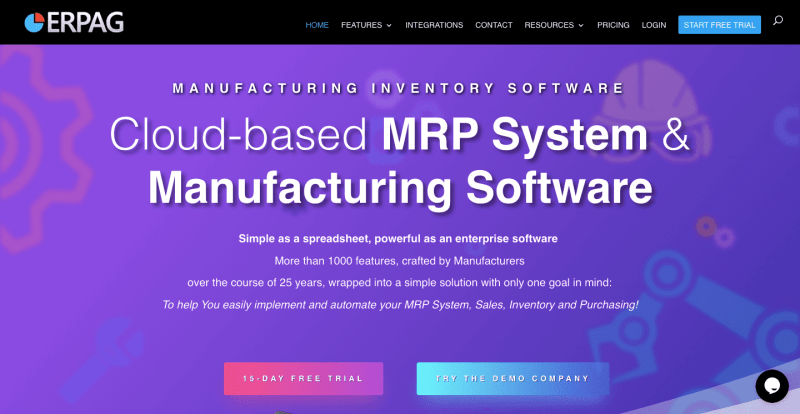
ERPAG is a cloud-based MRP solution that has over 1,000 built-in features inspired by real manufacturers. The developers say their platform is one of the most user-friendly. “Simple as a spreadsheet, powerful as an enterprise software”, — they state.
Indeed, ERPAG is one of the most easy-to-use MRP systems on our list. The dashboard interface is similar to popular CMS with large buttons and icons and convenient menus. Drag-and-drop functionality is also available.
The functionality is pretty standard for manufacturing software: sales and CRM, inventory management, supply chain, dropshipping, customer portal (for B2B customers), automated backup, user permissions, and more. The built-in feature set is pretty good but the real magic is in customization capabilities of ERPAG. Because of this flexibility, ERPAG is often chosen by companies that outgrow simple inventory tools but are not yet ready for a full-scale ERP implementation.
In ERPAG, you can add additional business logic or custom based inputs without coding knowledge. You can expand the system by integrating it with third-party business applications. For example, the system is seamlessly integrated with Google applications, USPS, FedEx, and UPS carriers. The system works with Magento, Shopify, Magento, QuickBooks, and Xero.
This is the second MRP solution on our list after Katana that is 100% suitable for eCommerce.
Rating on Capterra: 4.5 out of 5
4. Deskera MRP
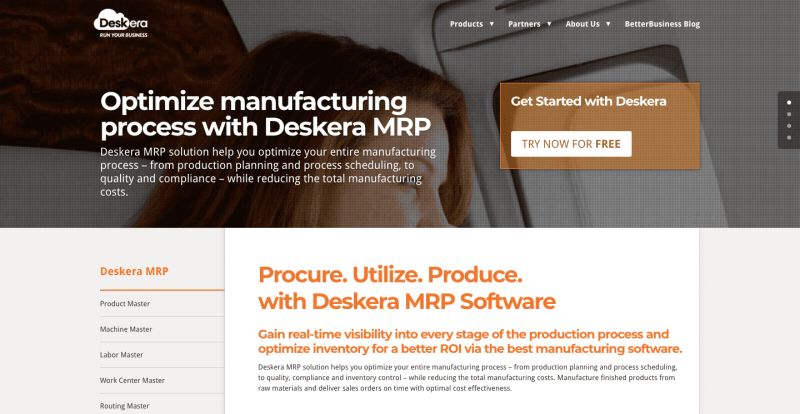
Deskera MRP is a cloud-based manufacturing software for businesses of all sizes. As any proper MRP system, Deskera aims to reduce manufacturing costs by optimizing production planning, sales, and inventory control. One of their key clients is Mitsubishi Electric.
Deskera MRP solution offers all the necessary functions for small and medium enterprises, plus some advanced features for large manufacturing facilities: you can record product data, manage factory machines, generate master production schedule, manage work orders, perform quality checks and demand forecasts. Deskera is particularly suitable for businesses operating across multiple regions, as its modules for finance and HR allow a company to consolidate operational data into a single ecosystem.
We didn’t find any mentioning of the integration capabilities on their official website but users on Capterra say that this MRP solution can be integrated with popular third-party business applications hassle-free.
Rating on Capterra: 3.9 out of 5
5. Odoo
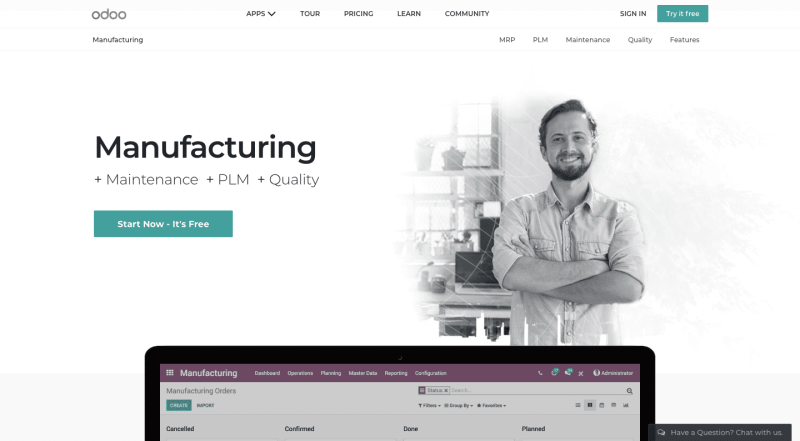
Odoo is one of the most popular MRP solutions among mid-sized manufacturers, especially those looking for a modular cloud-based system. The package includes MRP, maintenance, PLM, and quality programs. The solution is quite popular: according to the developers, over 4 million users have grown their businesses with Odoo.

In our opinion, the Odoo manufacturing system is not as easy to use as you expect. You will probably need minor training to master the program. Overall, the interface is similar to most of the popular MRP/ERP systems. The cool thing about Odoo is that it shows big and informative diagrams. Another advantage is its modular architecture: manufacturers can start only with the MRP module and gradually add inventory, quality, PLM, or maintenance tools as their processes mature.
The program has all the essential features for inventory management and planning automation: accurate planning directly based on real manufacturing times measures, real-time communication tools, the ability to connect to equipment via API, barcodes, reports and KPI, and more.
Speaking about integrations, the Odoo MRP system offers API to connect to equipment. This gives more flexibility in material and resource planning because the system can get up-to-date data from the machines via API. The website also says the system is open-source, which could also give more opportunities in terms of customizations and integrations.
Rating on Capterra: 4.2 out of 5
6. Statii
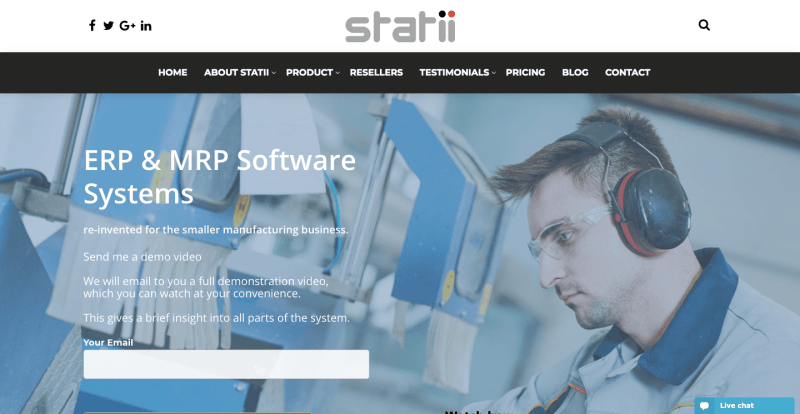
Statii is known for its super-friendly interface made for end-user. All the important dashboard elements are highlighted in certain colors, so you’ll always know where the button is. Clicking on any of the colored title buttons takes the user to the next screen. Simple filters are used to generate reports and show statistics.
Statii has all the must-have functionalities for inventory management, planning, and sales automation: customer/supplier management, inquiries/quotations, sales orders, purchase orders, route carts, scheduling, diary, delivery management, invoices, and more.
Looks like Statii is quite a closed MRP system so there are not many integration capabilities. However, its simplicity makes Statii a good fit for companies that want a controlled environment without the complexity or risks that come with third-party extensions. Also, it is one of the most expensive solutions on our list.
Rating on Capterra: 4.7 out of 5
7. JobScope MRP
JobScope MRP is a software complex for government contractors, job shops and maintenance repair, and overhaul manufacturing companies. This is on-premise software, which means you install it locally. In our opinion, this is one of the most complicated MRP systems to master yet one of the most powerful.
The features include purchasing, stock inventory, issues, receiving, inspection, quality control, shipping, materials requirements planning MRP, job inventory, stock inventory, and both lot and serialized inventory. All the essential features are present, as well as some advanced functions for big enterprises.
Because JobScope is an on-premise software, they charge you only once for the license. JobScope is especially valuable for industries with strict compliance requirements, where storing sensitive operational data on local servers is mandatory. Despite its self-hosted nature, JobScope is limited in terms of customization.
Rating in Capterra: 4.3 out of 5
Summary
This article highlights several top-rated MRP solutions tailored for B2B manufacturers and growing enterprises. In conclusion, the MRP solution is an indispensable tool for businesses in the sphere of manufacturing. MRP software for small businesses is not an issue of necessity, moreover, most MRP systems are not adapted to small business at all.
We hope that our list of best MRP systems will be beneficial for you. Remember that companies that use MRP increase their automation and boost their business. Only by appropriate planning can you find a key to success.