Top 10 eCommerce Fulfillment Companies for Marketplaces in 2025
In recent years, fulfillment companies have become a vital component of eCommerce, providing sellers with comprehensive logistics solutions for efficient marketplace operations. In this article, we review the 10 best fulfillment services of 2025, highlighting their capabilities, advantages, and the diverse logistics options they offer to enhance order processing, storage, and delivery efficiency.
If you’re looking for the best fulfillment companies to scale your eCommerce operations, this guide offers a detailed overview of the top providers in 2025.
What is Fulfillment?
Fulfillment is a set of services that includes warehousing, packaging, product labeling, and delivery of customer orders. There are two main models of operation: FBO (Fulfillment by Operator — delivery from the marketplace’s warehouse) and FBM (Fulfillment by Merchant— delivery from the seller’s warehouse). In the first fulfillment model, the marketplace operator oversees all order processing from a centralized fulfillment warehouse, ensuring timely delivery and consistent service. In the second model, the seller independently manages certain aspects of the fulfillment process, allowing for greater flexibility and operational control.
Key Global Fulfillment Statistics for 2025
- The global eCommerce logistics and fulfillment market is projected to grow by 15.5% in 2025, reaching a value of over €600 billion (approximately $653 billion), up from €521.9 billion ($569 billion) in 2024, effectively doubling since 2019 (Global Newswire).
- The eCommerce fulfillment services market is estimated to be worth $123.7 billion in 2025, reflecting a 12.9% year-over-year growth, with North America accounting for approximately 25% of the global market and the Asia-Pacific region representing 27% (Capital One Shopping Research).
- Global eCommerce sales are forecasted to reach $7.39 trillion in 2025, up from $6.15 trillion in 2023, highlighting the massive scale of online retail driving fulfillment demand (Waredock).
- The warehousing market, a critical component of fulfillment, is expected to reach $869.32 billion by 2025, with approximately 180,000 warehouses worldwide providing much-needed warehouse space for eCommerce growth (Omniful).
- Regional growth rates since 2020 have shown the Asia-Pacific leading with 11% growth, followed by North America at 10%, and Europe at 8%, reflecting substantial expansion in both emerging and mature markets (Global Newswire).
- Cross-border e-Commerce is growing at an estimated 15–20%, further boosting demand for international fulfillment centers and complex logistics solutions (Omniful).
- Approximately 60% of online retailers outsource at least part of their order fulfillment services, with 20% outsourcing their entire fulfillment process, indicating a strong reliance on third-party logistics providers (3PLs) (Capital One Shopping).
- Large-scale mergers and acquisitions are ongoing as bigger logistics groups with established relationships acquire smaller specialists to capitalize on e-commerce growth and enhance service capabilities (Parcel and Postal Technologies International).
These trends highlight the crucial importance of efficient, technology-enabled fulfillment networks in meeting the demands of a rapidly growing global online shopper base.
Why Do Marketplaces Need Fulfillment?
Fulfillment is a strategic asset for online marketplaces, and a well-planned fulfillment strategy tailored to your business needs can reduce operational complexity and accelerate time to market. It helps automate order processing, boost logistics efficiency, and shorten delivery times. For many marketplaces, partnering with a reliable shipping fulfillment company is the easiest way to reach this level of operational maturity.
A seamless eCommerce fulfillment process helps ensure fast delivery, accurate order handling, and a better customer experience. By outsourcing logistics to professional fulfillment providers, marketplaces can avoid the high costs of building and managing their warehouse infrastructure.
These marketplace fulfillment solutions eliminate the need to invest in logistics infrastructure, offering a faster route to growth and supporting an international presence. Outsourcing fulfillment is especially beneficial for startups and SMBs that lack the capacity to manage warehousing and logistics in-house.
Fulfillment also supports business scalability. International shipping adds complexity to order fulfillment, which is why working with experienced providers is essential for global marketplaces.
This makes it crucial for marketplaces to partner with services that can manage a scalable and reliable order fulfillment process. As order volumes and product assortments grow, fulfillment partners make it easy to increase throughput without operational overload. Many fulfillment companies offer scalable inventory storage solutions tailored to your sales volume and product types, reflecting trends similar to those observed across Top Online Marketplaces in Australia.
Delegating warehousing and shipping to experts enables marketplace operators to focus on their core activities—improving the customer experience, onboarding new sellers, growing revenue, and expanding their customer base. An efficient fulfillment setup directly contributes to sales growth by improving delivery speed, customer satisfaction, and repeat purchase rates.
For vendors, fulfillment minimizes the time spent on logistics, freeing up resources to focus on marketing and sales. Providers that support demandware shipping fulfillment can further streamline order routing across multiple sales channels. Custom packaging helps strengthen brand identity and enhance the unboxing experience for customers.
Fulfillment directly impacts customer satisfaction, as delays, stockouts, or incorrect shipments can negatively affect brand loyalty. Strategically located warehouses allow marketplaces to offer faster shipping, reduce shipping costs, and meet regional delivery expectations. Fulfillment companies often operate many fulfillment centers across different regions to ensure faster delivery and reduce last-mile delays. Reliable eCommerce logistics providers help marketplaces maintain delivery speed and service quality during peak seasons.
How to Choose a Fulfillment Provider?
When choosing a fulfillment service for your marketplace, integration and functionality are key. The right fulfillment partner should not only store and ship your products but also offer tools for real-time inventory management, order management, return handling, and performance analytics. Many fulfillment service providers offer specialized tools for managing inventory, tracking shipments, and handling returns efficiently.
Some providers specialize in high-volume enterprise clients, while others focus on startups and small brands—offering flexible pricing models with low upfront costs. Evaluate each provider’s network, platform compatibility, and support for multichannel operations. Each marketplace should evaluate whether the fulfillment partner uses an in-house or outsourced delivery service or works with external shipping carriers, as this can affect delivery speed and reliability. Choosing among the best fulfillment companies requires analyzing your scale, delivery needs, and system integrations.
Core Fulfillment Services for Marketplaces
- Warehousing in strategic global locations (e.g., U.S., Europe, Asia-Pacific) for faster delivery to end customers
- Order picking and branded packaging based on marketplace requirements
- End-to-end fulfillment shipping, from warehouse pick-up to last-mile delivery
- Returns management, including inspection and restocking of returned products
- Product labeling and barcoding to automate inventory handling
- Climate-controlled storage for perishable or sensitive goods
Software Integration Capabilities
- API integration with popular eCommerce platforms (e.g., CS-Cart, Magento, WooCommerce) and marketplaces (e.g., Amazon, eBay) along with real-time shipment visibility through multi-carrier tracking APIs
- Centralized dashboard to manage pricing, orders, and inventory across channels
- Real-time inventory updates, low-stock alerts and backorder notifications
- Automatic order status syncing with customer-facing systems
- Integration with analytics and performance monitoring tools
Key Fulfillment Models Supported
- FBO (Fulfillment by Operator) – the fulfillment provider handles all logistics from its own warehouse
- FBM (Fulfillment by Merchant) – the seller stores products and ships directly with fulfillment support
- Hybrid/On-Demand Models – combining multiple delivery and storage options across regions
Each eCommerce fulfillment provider in our list offers unique strengths depending on your marketplace’s scale, delivery expectations, and need for multiple locations.
Top eCommerce Fulfillment Companies in 2025
1. ShipBob
ShipBob is a tech-enabled 3PL with an extensive network of warehouses in strategic locations across North America, Europe, and Australia.
- Features: Branded packaging, inventory forecasting, 2-day or same-day delivery.
- CS-Cart Integration: API-based connections are possible via middleware solutions like Zapier or through custom development.
- Best For: DTC brands expanding internationally with a focus on speed.
2. Deliverr (part of Flexport)

Specializes in 1–2 day nationwide US delivery, integrated into Flexport’s global network.
- Features: Predictive analytics, multi-channel fulfillment, and cost-effective operations make Deliverr ideal for sellers focused on minimizing fulfillment costs.
- CS-Cart Integration: can be connected through Flexport API or third-party platforms.
- Best For: Sellers prioritizing speed and cost-efficiency in the US.
3. ShipMonk
Global fulfillment with warehouses in the US, EU, Canada, and Mexico.
- Features: Over 100 integrations, supports crowdfunding and subscription models.
- CS-Cart Integration: possible via middleware or custom API development.
- Best For: eCommerce brands scaling internationally, especially subscription models.
4. Fulfillment by Amazon (FBA)
Fulfillment by Amazon (FBA) for CS-Cart involves utilizing Amazon’s warehouses and fulfillment services to ship customer orders through Amazon Multi-Channel Fulfillment, typically via third-party or custom integrations.
The CS-Cart Amazon FBM add-on is a popular official extension that connects CS-Cart to Amazon for sellers who fulfill orders themselves (FBM), enabling order and inventory synchronization but not Amazon fulfillment.
Sellers wanting full FBA integration often rely on middleware or custom API solutions to automate order routing from CS-Cart to Amazon fulfillment centers.
- Features: Inventory handling, order processing, customer service, returns.
- CS-Cart Integration: ✅ Supported—via CS-Cart Amazon FBM add-on (Webkul) for managing merchant-fulfilled orders.
- Best For: Sellers leveraging Amazon’s marketplace and logistics.
5. Red Stag Fulfillment
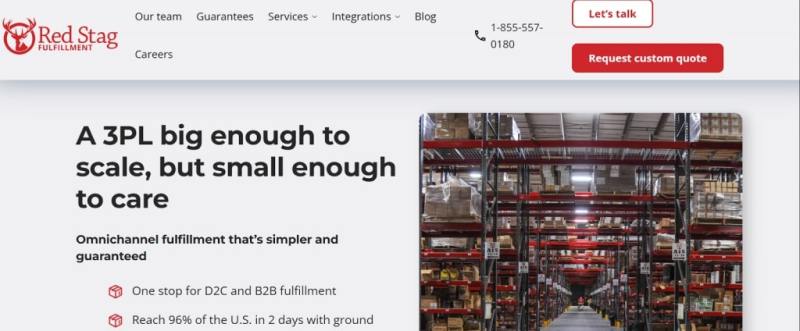
US-based 3PL recognized for its high accuracy and same-day shipping capabilities.
- Features: 100% order accuracy guarantee, free trial.
- CS-Cart Integration: ✅ Direct integration available.
- Best For: Businesses that require high-speed, accurate US fulfillment.
6. FedEx Fulfillment
Backed by FedEx’s global network with full end-to-end fulfillment logistics and supply chain services.
- Features: Global logistics, reverse logistics, returns, multi-channel.
- CS-Cart Integration: ⚠️ Shipping modules available with partial fulfillment workflows.
- Best For: SMBs needing global reach with a trusted logistics provider.
7. SHIPHYPE
3PL tailored for fast and automated fulfillment.
- Features: Transparent pricing, API/webhook-based automation.
- CS-Cart Integration: ✅ Direct integration with CS-Cart via API/webhooks.
- Best For: CS-Cart stores seeking easy automation and scalability.
8. CrescoData
Middleware platform for syncing orders, inventory, and products across channels.
- Features: Multi-channel sync, supports marketplaces.
- CS-Cart Integration: ✅ Works with CS-Cart for large-scale syncing.
- Best For: Multi-channel sellers with complex product/inventory management.
9. eFulfillment Service (EFS)
eFulfillment Service is known as a budget-friendly 3PL focused on SMBs.
- Features: Web-based tools, free integration support.
- CS-Cart Integration: ✅ Direct integration available.
- Best For: SMBs and startups needing cost-effective fulfillment and automation.
10. AMZ Prep
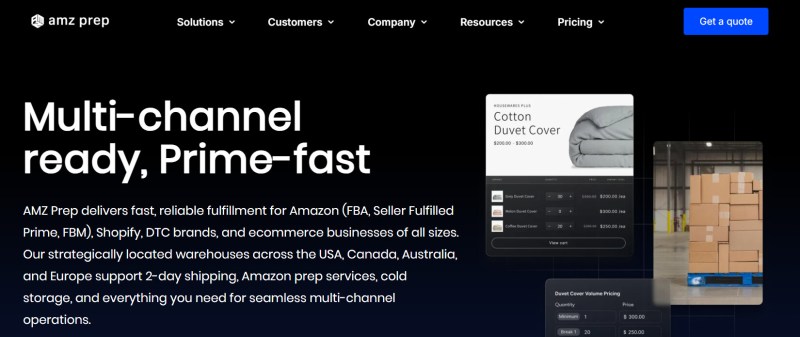
AMZ Prep is a tech-enabled 3PL founded in 2016 with an extensive fulfillment network of 50+ strategic locations across North America (USA, Canada), Europe, and Australia.
- Features: FNSKU labeling, poly bagging and bubble wrapping, bundle creation and kitting, inspection and quality control, case forwarding with zero placement fees, temperature-controlled storage, Seller Central integration, 24-72 hour processing..
- CS-Cart Integration: ✅ API-based connections are possible via middleware solutions like Zapier or through custom development using their proprietary technology platform.
- Best For: Amazon FBA sellers looking for comprehensive prep services with fast processing times, DTC brands requiring multi-channel fulfillment (Shopify, TikTok, Walmart), and sellers expanding internationally with a focus on eliminating placement fees and storage optimization..
Summary Table
Here’s a side-by-side comparison of the top fulfillment companies and what makes them ideal for different business types.
| Provider | Regions Served | Key Features & Fulfillment Models | API/Middleware Integration Status | Best For / Notes |
|---|---|---|---|---|
| ShipBob | US, EU, AUS | Branded DTC fulfillment, fast delivery, omnichannel (DTC & B2B), subscription support, temperature-controlled warehousing, FBA prep. Supports FBM (seller ships inventory to ShipBob warehouse), and can support hybrid models. | Integrations via middleware or custom | DTC brands expanding internationally; strong WMS and lot tracking for consumables |
| Deliverr (Flexport) | US | 1–2 day delivery, predictive inventory placement, primarily FBM (seller sends inventory to Deliverr warehouses). Supports Flexport API for integration. | ⚠️ Integration via Flexport API | US sellers prioritizing speed & cost efficiency; strong predictive fulfillment |
| ShipMonk | US, EU, Canada, Mexico | Subscription & crowdfunding support, omnichannel fulfillment, FBM model (inventory stored at ShipMonk warehouses). Advanced OMS and WMS with real-time visibility. | Middleware or API-based integrations | Global ecommerce scaling with subscriptions and complex workflows |
| Fulfillment by Amazon (FBA) | Global | FBO model: seller sends inventory to Amazon fulfillment centers; Amazon handles storage, packing, shipping, returns, and customer service. Also supports FBM (Fulfillment by Merchant) for seller-handled fulfillment. | ✅ Amazon FBM addon for CS-Cart and other platforms | Sellers using Amazon ecosystem; global reach and Prime shipping |
| Red Stag Fulfillment | US | High accuracy, same-day fulfillment, FBM model (inventory at Red Stag warehouses). Supports hybrid fulfillment models combining multiple 3PLs or in-house. | ✅ Direct API integration | US-based sellers needing accuracy-critical fulfillment; supports hybrid fulfillment |
| FedEx Fulfillment | Global | Trusted brand, full supply chain services, primarily the FBM model (inventory at FedEx warehouses). Partial integration via shipping modules. | ⚠️ Integrations via shipping modules | Global SMBs needing reliable logistics and fulfillment |
| SHIPHYPE | US, Global | Transparent, automated 3PL, full API integration with CS-Cart. Supports FBM and hybrid fulfillment models. | ✅ Full API integration | CS-Cart sellers needing fast 3PL setup and automation |
| CrescoData | Global (middleware) | Real-time multi-channel sync, middleware platform connecting CS-Cart with marketplaces and fulfillment providers supporting FBM and DBS models. | ✅ Middleware platform | Omnichannel syncing for CS-Cart; supports flexible fulfillment models |
| eFulfillment Service | US | Affordable, web-based platform, direct integration with CS-Cart. Supports FBM model. | ✅ Direct integration | Small businesses using CS-Cart seeking simple fulfillment |
| AMZ Prep | US, Canada, EU, AUS | FNSKU labeling, poly bagging, bubble wrapping, bundle creation/kitting, inspection & QC, case forwarding (zero placement fees), Seller Central integration, temp-controlled storage. Supports FBM and hybrid. | ✅ API-based via middleware (Zapier/custom API) | Amazon FBA sellers needing prep services, DTC brands requiring multi-channel fulfillment (Shopify, Walmart, TikTok), sellers expanding internationally efficiently |
Conclusion: How to Choose a Fulfillment Provider?
Fulfillment companies have become indispensable partners for online marketplaces, enabling sellers to concentrate on business growth and expansion while minimizing logistics challenges. Best eCommerce fulfillment companies offer the technology, infrastructure, and scale needed to keep up with rising customer expectations.
As the demand for fulfillment services continues to rise, selecting a trusted and reliable partner is increasingly crucial for ensuring the long-term success and scalability of your eCommerce business. For marketplaces, delivering consistently high customer satisfaction is only possible with a reliable and scalable fulfillment solution. Partnering with a third party logistics company reduces the need for capital investment in warehouses and staff, while providing enterprise-level fulfillment capabilities.
⚡ What to Consider When Choosing a Fulfillment Provider:
✔ Compatibility with your marketplace’s operating model (FBO, FBM, hybrid)
✔ Integration with your sales channels (e.g., Amazon, eBay, Walmart, Etsy)
✔ Order and return processing speed
✔ Flexible pricing and storage conditions
💡 Remember: Choosing the wrong fulfillment partner can lead to delays, damaged goods, and higher return rates—hurting your brand and profits.
Ready to connect a fulfillment partner? Explore our list of top-rated fulfillment services and select the one that ensures fast, reliable, and scalable logistics for your marketplace. Our curated list of the best order fulfillment companies in 2025 helps you choose the right partner for your marketplace.
All CS-Cart Products and Services
- ★ CS-Cart Multi-Vendor: free online demo
- ★ CS-Cart Store Builder: free online demo
- ★ Mobile App: App Store, Google Play
- ★ Cloud Hosting: why it’s the best for CS-Cart
- ★ Customer Care: why it’s more than just a tech support
- ★ Upgrade subscription: select and reactivate

Gayane is a passionate eCommerce expert with over 10 years in the industry. Her extensive experience includes marketplace management, digital marketing, and consumer behavior analysis. Dedicated to uncovering the latest eCommerce trends, she ensures her readers are always informed about industry developments. Known for her analytical skills and keen eye for detail, Gayane's articles provide actionable insights that help businesses and consumers navigate the ever-evolving digital commerce landscape.