
How to Come up with a Business Name: Tips, Tools, and Creative Ideas
Creating a business name is often the first big creative milestone for eCommerce entrepreneurs. But it is also one of the most underestimated steps in establishing a successful online project.
A business name is your first impression, your digital identity, and the foundation of your brand story. Many founders struggle here, bouncing between uninspired ideas or getting stuck on names that are either taken or do not fit the business vision.
In this guide, you will learn how to create a business name that feels authentic, performs well in search, and leaves a lasting impression. From brainstorming to legal checks, this is your roadmap to naming your business with confidence.
Why Your Business Name Matters
A strong, memorable name builds trust, conveys professionalism, and helps differentiate the business in a crowded market. It also plays a key role in searchability and branding across digital platforms. An effective name can influence customer perception and drive long-term loyalty.
The Role of Your Name in Branding, Marketing, and Customer Perception
Your name sets the tone for everything else. Effective business naming makes it easier for your audience to connect emotionally with your company. Whether you are selling eco-friendly cosmetics or custom car parts, your business name tells your audience who you are and what you care about. It is central to your brand positioning and marketing messaging.
Take GreenPan, for example. It is instantly clear, eco-conscious, and product-relevant. Compare that to a vague name like “KitchenX”, which says nothing about your values.
| Name | Type | What it communicates | Effect on perception |
|---|---|---|---|
| GreenPan | Descriptive / Suggestive | Eco-friendly cookware | Clear values, instant relevance |
| KitchenX | Vague | Nothing specific | Weak positioning, low trust |
First Impressions and Memorability
Most people will not give you a second chance if your name doesn’t grab them. You need a name that is short, punchy, and emotionally resonant. A catchy business name should instantly communicate what makes your business special and worth remembering.
Names like “Snug” (for home goods) or “Boomf” (for marshmallows) work because they are surprising and stick in your memory. That is how you make a brand name that lingers. Strong memorability directly strengthens brand recall, especially in competitive eCommerce markets.
SEO and Digital Presence
The right name can make or break your online visibility, because search engines reward uniqueness and relevance. If you pick something too generic (e.g., “Best Shoes”), you will struggle with search. For SEO, aim for semantic relevance: a name that naturally connects to what you sell without becoming keyword-stuffed.
Make it too obscure, and no one finds you. The idea is to strike a balance with unique names that allow for domain ownership, easy searchability, and a digital presence you can own across platforms.
What Makes a Good Business Name?
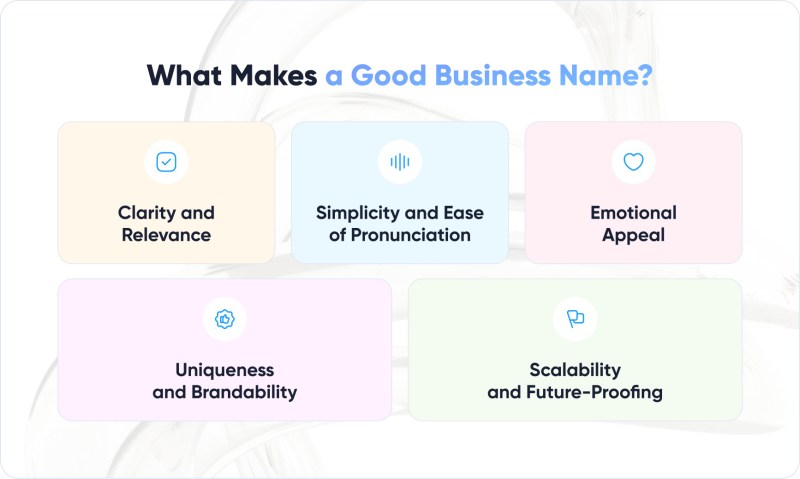
Not all business names are created equal. The best names are not just creative. They are strategic. Here is what you should aim for when you set out to name a business the right way.
Clarity and Relevance
Your business name should give people a clue about what you do or stand for, at least emotionally. A name like Dropbox does not spell everything out, but it is still relevant. “Box” and “Drop” suggest storage and sharing.
Simplicity and Ease of Pronunciation
Always aim to make a business name that people can say and spell without hesitation. If people can’t say it, they can’t share it. If they can’t spell it, they can’t Google it. Avoid complex names like “Xyzzthos” and go for clean, easy-to-pronounce names. Lume, Stripe, and Clare are great examples.
Emotional Appeal
Creating a business name that evokes a feeling is more powerful than one that just describes a function. When you brainstorm creative names for business, think about the emotions you want to trigger in customers. Think Innocent Drinks or Calm. These brand names connect emotionally. There is something a feature-focused name rarely achieves.
Uniqueness and Brandability
When you create a brand name, make sure it is not just available. It should also feel brandable.
Does it look good in a logo? Can you imagine it on packaging or in an ad campaign?
Brandability means thinking beyond just words. It also supports long-term brand differentiation, helping your name remain recognizable as competitors enter the market.
Scalability and Future-Proofing
Pick a business name that can grow with you. Your company name should grow with you, staying relevant even as you expand into new markets. If you start as a t-shirt shop and name your brand “ShirtVerse,” what happens when you expand to bags or accessories? Avoid boxing yourself in. That’s why it helps to choose a business idea with growth potential—like those in this list of high-potential eCommerce business ideas.
Types of Business Names
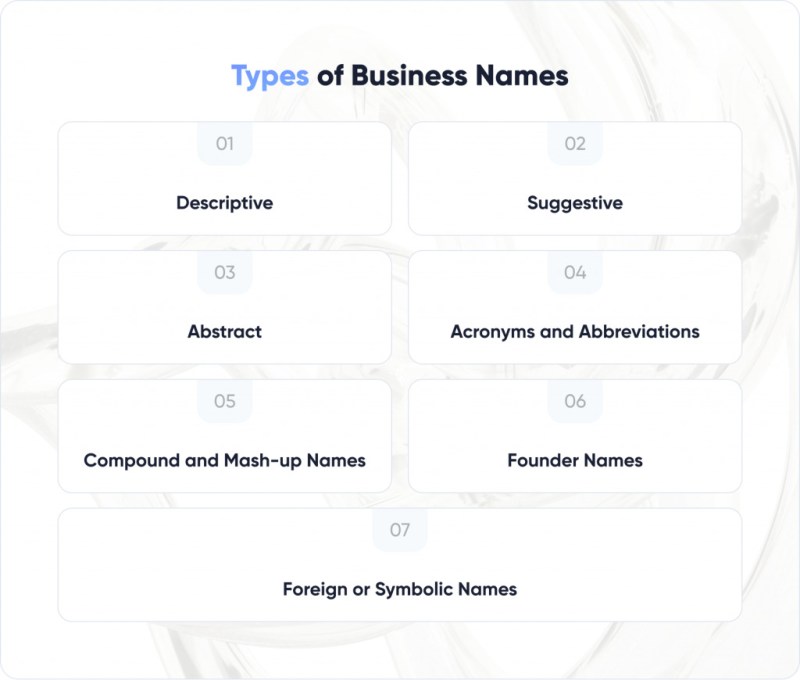
There is no one-size-fits-all formula when it comes to creating a business name. But understanding the categories can help you explore ideas that align with your brand personality.
Descriptive
These names say exactly what you do. Think The Shoe Company or Books-A-Million. Descriptive names can be clear, but because they’re so common, they’re often used by other businesses, making them hard to protect legally.
Suggestive
Names that hint at what you do while leaving room for creativity. Examples: Pinterest (pin + interest) or Spotify (spot + identify). Great for emotional and conceptual branding. Suggestive names balance creativity with clarity, which makes them powerful tools for brand recognition.
Abstract
Totally invented names like Zappos, Kodak, or Xero. Abstract names may take longer to explain, but their uniqueness often makes them more future-proof.
Acronyms and Abbreviations
Useful if your original name is long (e.g., IBM, H&M). Be careful, as acronyms are not memorable unless you already have a lot of brand equity.
Compound and Mash-up Names
Blending words into new ones, like Facebook, Netflix, or Shopify. A great way to create uniqueness.
Founder Names
Some brands use the founder’s name or even the names of family members to add a personal touch: Dell, Ford, Ben & Jerry’s. It can work well for small business names and boutique brands. For small startups, having a catchy business name can make up for a limited marketing budget by creating instant word-of-mouth buzz.
Foreign or Symbolic Names
Use foreign words or symbols to create intrigue. Brands like Haagen-Dazs or Fjällräven evoke culture and identity. Just be sure it translates well.
Choosing the Right Type of Business Name
| Type | Description | Pros | Cons | Examples |
|---|---|---|---|---|
| Descriptive | Says what you do | Clear | Hard to protect | The Shoe Company |
| Suggestive | Hints at value | Emotional + clear | Needs explanation | Spotify |
| Abstract | Invented | Unique | Needs branding | Zappos |
| Acronym | Shortened name | Compact | Low recall | IBM |
| Mash-up | Blended words | Brandable | Trend risk | Netflix |
| Founder name | Personal | Authentic | Hard to scale | Dell |
| Foreign | Cultural meaning | Distinctive | Translation risk | Fjällräven |
Step-by-Step Guide: How to Come Up With a Business Name
Choosing a business name that hits the mark doesn’t have to feel overwhelming. Follow this structured, step-by-step process to find a name that is strategic, creative, and brand-worthy. This process turns scattered thoughts into focused name ideation that supports real business goals.
Step 1: Define Your Brand Identity
Mission, vision, values, target audience
Start by getting crystal clear on what your brand stands for. Ask yourself:
- What do you sell?
- Who do you serve?
- What emotions should your name evoke?
When you choose a business name, your mission, vision, core values, and target audience should all guide your decision. Together, these elements form the foundation of an effective naming strategy, rather than a collection of random name ideas.
A fun, youth-driven fitness brand will need a completely different tone than an elegant, high-end skincare company. If you’re planning to launch a fashion boutique, here’s a dedicated guide on how to start an online boutique to help you align your name with your niche.
Tone and style you want to convey
Decide how you want your brand to sound and feel. Should it be playful, professional, edgy, or luxurious? This tone will guide your naming choices and help you stay consistent.
Step 2: Brainstorm Name Ideas
Word dump
Start by listing every word that comes to mind related to your product, industry, and values. At this stage, you’ll gather raw ideas and start to create business name variations from different angles. No filter, just let it flow.
Use a thesaurus
Look up your list of potential names in a thesaurus to find synonyms, metaphors, or lesser-known alternatives.
Explore mythology, pop culture, foreign words
Get inspiration from stories, historical figures, pop culture references, or words in other languages that reflect your brand personality. Market research can also reveal whether certain keywords, metaphors, or cultural references connect positively with your audience.
Consider sound symbolism
Think about how your name sounds. Is it harsh or soft, fast or slow? Sound symbolism influences perception more than you might think.
Mash-up concepts
Combine words or parts of words to create something new (think “Netflix” or “Mailchimp”).
Play with spelling and wordplay
Tweak spellings, use rhymes, puns, or alliteration to add a clever twist that makes the name more memorable. This approach relies heavily on linguistic creativity to shape names that feel playful yet intentional. To avoid accidental weirdness, do a simple linguistic analysis: pronunciation, stress, and how it sounds out loud.
Consider using your own name
Do not be afraid to use your own name or nickname, as it adds a personal touch and works especially well for personal brands or consultancies.
Business Name Brainstorming Techniques
| Technique | How it works | When to use |
|---|---|---|
| Word dump | Raw keyword list | Early ideation |
| Thesaurus | Synonyms & metaphors | Finding alternatives |
| Sound symbolism | Focus on phonetics | Emotional branding |
| Mash-ups | Combine word parts | Brandable names |
| Foreign words | Borrow meaning | Global or premium brands |
| Wordplay | Rhymes, puns | Playful brands |
Step 3: Use Tools and Generators (Optional)
Business name generators
Try free tools like Shopify’s Business Name Generator to kick-start your ideas.
AI-powered suggestions
Platforms like Namelix use AI to generate creative name options based on keywords.
Name combining tools
Tools like NameMesh can help you blend ideas and even check domain availability while you’re at it.
Step 4: Shortlist and Evaluate
Is it easy to spell, pronounce, and remember?
Avoid names that are hard to say or spell. You want people to recall it effortlessly and share it easily.
Does it fit your industry?
Make sure your name feels appropriate for your niche. It should resonate with your specific audience and market. For example, if you’re selling gadgets or tech, this guide to selling electronics online will give you ideas on naming conventions in the category.
Is it emotionally engaging?
A great name stirs emotion or sparks curiosity. If it feels bland, keep searching.
Does it align with your brand story?
Your name should support the bigger story you’re telling about who you are and what you offer. If it can subtly reinforce your value proposition, it will work harder in marketing without extra explanation.
Step 5: Check Availability
Domain name check
Make sure your desired domain is ideally a .com. Check if it is available or easily adaptable. Every business owner should take the time to run a trademark and domain check before falling in love with a name.
Read more: Tips for Choosing Your E-Commerce Domain Name
Trademark search
Use resources like the USPTO (or your local trademark office) to ensure your name is not already claimed, and double check similar variations that might cause conflicts. In addition to trademarks, some companies also register a service mark if their business provides services rather than physical goods. A trademark or service mark provides legal protection, ensuring competitors cannot use a confusingly similar name.
Social media handles
Check whether your name (or a close variation) is available across major platforms, since social availability is just as important as domain ownership.
Business registry availability (by country/state)
Confirm the name is available in your business registry to avoid potential legal issues. Every business owner should also confirm that the chosen name fits the legal requirements for their business entity to avoid complications later.
Step 6: Get Feedback
From potential customers
Ask people in your target audience what they think. Do they find it appealing, memorable, or confusing? When you run feedback sessions, explain the business idea behind each name so people can judge how well it fits.
From business partners and the team
Bring in your co-founders or team for input. They will bring valuable perspectives you might have missed.
A/B testing name options
Try running polls, ads, or social media tests to see which name performs better in real-world scenarios.
Step 7: Make the Final Choice
Test for longevity, flexibility, and scalability
Will this name still work if you expand your product line or go global? Make sure it can grow with your business.
Sleep on it
Sit with your top choice for a day or two. If it still feels like the perfect business name, that’s a good sign.
Visualize branding and logo use
Picture how the name looks in a logo, on packaging, and across your website or storefront. This quick visualization helps you check whether the name aligns with your company brand identity in real use. And if you’re building a platform for multiple sellers, check out this step-by-step guide to creating an eCommerce marketplace—your name should reflect the scale of your vision.
Don’t agonize over perfection
No name is perfect. Choose one that feels aligned and strong, then commit. A great name becomes iconic through brand-building, not just clever wording. That idea sits at the heart of business branding basics: consistency and meaning beat one-time cleverness.
Mistakes to Avoid When Naming a Business
Many mistakes happen when coming up with a business name, like following short‑lived trends or choosing names that limit growth. Naming mistakes are common, but with a bit of foresight, they’re totally avoidable. Deciding on a business name is more than a creative exercise; it’s a strategic move that can impact brand perception, customer trust, and long-term scalability. Below are some of the most dangerous pitfalls to avoid when naming your business.
Following Trends Blindly
Trendy suffixes like “-ify,” “-ster,” or “-ly” can make a name feel modern, but they often become dated quickly and may lack long-term resonance.
If you’re using these suffixes without a deeper brand connection, your name may sound generic or gimmicky.
Names like “Snappify” or “Grubster” might sound catchy now, but could feel stale in a few years. Focus on timeless value, not short-term hype.
Overcomplicating or using confusing spelling
Unusual or overly creative spellings can backfire. While you might think a name like “KwykKart” stands out, it’s likely to confuse people trying to search for you online or recommend you through word of mouth.
If customers can’t spell, pronounce, or remember your name easily, you’re making their journey to your brand unnecessarily difficult and possibly losing business in the process.
Using narrow or limiting terms
Choosing a name that is too specific can box you in. “OnlyMugs” might work great if you only plan to sell coffee mugs. But what happens when you want to expand into tumblers, apparel, or accessories?
A narrow name can make scaling your business harder and force a costly rebrand later. Instead, choose a name with built-in flexibility that allows your brand to grow organically.
Neglecting cultural or linguistic context
Always consider how your business name translates across cultures and languages. A word that sounds fine in English might carry negative connotations, be offensive, confusing or even laughable in another country.
For example, brands have historically run into trouble with names that unintentionally translate to inappropriate or negative terms in foreign markets. A simple global check can save you from future embarrassment or damage to your brand image.
Forgetting legal checks
One of the most critical steps in naming your business is conducting a proper legal check. Skipping trademark searches, domain availability, and social media handle checks can lead to legal trouble, disputes, or the inability to use your name altogether.
Always verify your chosen name is legally available before you commit. It is much easier to pivot early than to rebrand after launching.
Creative Ways to Come Up With a Business Name
Feeling stuck in the naming process? Don’t worry. It happens to every entrepreneur. The good news is that there are countless creative techniques to help you uncover a name that’s original, meaningful, and memorable.
Here are some of the most effective (and fun) ways to generate fresh business name ideas. Each method below is designed to spark creative brainstorming and unlock unexpected naming directions.
Word mashups and name blends
Blending two relevant words together can create a new, catchy name that communicates what your business does in a clever way.
Take “Groupon,” a mash-up of “group” and “coupon,” or “Pinterest,” which combines “pin” and “interest.”
Start by listing important keywords for your business and then experiment with how they might combine into a unique, brandable term.
Using metaphors or symbols
Some of the most iconic brands use metaphorical or symbolic names. “Apple,” for example, doesn’t describe computers. It evokes simplicity, curiosity, and approachability.
Think about nature, animals, or objects that align with your brand values. Metaphorical names can spark curiosity and create emotional resonance with your audience, even if they don’t directly describe your product. This effect is driven by layered semantic associations that grow stronger over time.
Language switching (Latin, French, etc.)
Borrowing words or roots from other languages can add elegance, sophistication, or global flair to your brand. Latin and Greek roots often sound timeless and professional (e.g., “Veritas” for truth).
French can add a luxurious tone, while languages like Japanese or Swahili might introduce beautiful, unexpected words that are both meaningful and unique.
Visual thinking and mind maps
Grab a pen and paper (or a digital tool) and start mapping out all ideas connected to your brand with products, emotions, values, colors, lifestyles, and so on.
From a single word like “freedom,” you might branch into concepts like “open,” “journey,” “sky,” or “flight,” each of which can inspire dozens of name ideas.
This visual technique can help you think beyond the obvious.
Use emotion-based brainstorming
Many businesses focus too much on what they do instead of how they want people to feel. Instead of naming your tech company after “software” or “data,” think about emotional reactions like “clarity,” “confidence,” or “speed.”
Emotional naming adds depth to your brand and makes it more relatable and memorable.
Use children’s or family names
Sometimes the best ideas come from unexpected places. Kids often think without the limitations adults have and can suggest surprisingly creative, fun, or whimsical names.
Even asking a friend or relative outside of your industry can provide a fresh perspective and unlock ideas you hadn’t considered. A family name in a brand can reflect traditions and values that you might want to share with your target audience.
Try rhyming or alliteration
Names that rhyme or use alliteration are easier to remember and more fun to say. Think of “Coca-Cola,” “PayPal,” or “Best Buy.”
The rhythmic quality makes these names stick. Try pairing different keywords until you find something that rolls off the tongue while still reflecting your brand.
Asking ChatGPT
AI can help you break through creative blocks. Provide a few keywords about your product or audience, and tools like ChatGPT can generate dozens of unique name ideas tailored to your niche.
It won’t make the final decision for you, but it can certainly give you a helpful starting point or spark a direction you had not even thought of.
What to Do After Creating a Business Name
Once you’ve landed on a name you love, the work isn’t over. Now it’s time to protect it, claim it, and start using it confidently.
Register the business name
Before doing anything public, make it official. Register your business name with the appropriate government agency in your country or state. This gives you the legal right to operate under that name and can protect you from competitors using a name that is too similar.
For example, in the U.S., you will typically register your business name when forming a limited liability company (LLC) or corporation.
If you are operating under a name different from your legal name, you will need to file a DBA (Doing Business As).
In the UK, it’s done through Companies House. Each region has its own rules. You should always check local requirements.
Secure domain and social handles
A business name without a matching domain is like a storefront with no door. Start by securing the .com version of your name if it’s available. If not, consider creative workarounds like:
- Adding a word (e.g., ShopNomad.com)
- Using industry-specific extensions (e.g., .store, .co, or .io)
- Buying the domain from a current owner if it’s a good investment
Don’t forget about social media. Consistent handles across social media platforms like Instagram, TikTok, X (Twitter), and Pinterest make your brand look professional and easy to find. Use tools like Namecheckr or BrandSnag to instantly scan availability across platforms.
Create a logo and visual branding
Once the name is yours, start building the brand around it. Design a logo that reflects your business’s personality. Choose fonts, colors, and imagery that speak to your audience. If design isn’t your thing, use platforms like Looka, Canva, or work with a freelance designer through 99designs or Fiverr. Another excellent option for custom logo and branding design is Crowdspring, which connects you with professional designers to bring your vision to life.
This is where your business name starts to come alive. Visual branding turns a good name into a recognizable brand.
Start using your name in marketing
Start using your name on your website, packaging, email signature, and social bios. The more consistently you use it, the more recognizable it becomes.
Tip: Even before your store launches, create a “Coming Soon” page with your new name and brand story. It builds anticipation and helps secure your online territory early.
Creative Business Name Ideas and Real Examples
A good name doesn’t just describe what you sell. It tells a story. It sparks curiosity, evokes emotion, and builds trust from the first click.
Let’s look at how successful eCommerce brands named themselves and how you can find similar inspiration. Some of today’s most successful companies started with nothing more than a household name and a bold vision. These examples can also spark fresh ideas for a business name for your own project.
How famous brands got their names
- Warby Parker. The founders created the name by combining characters from Jack Kerouac’s unpublished works. It sounds literary, stylish, and unique, which is perfect for a DTC eyewear brand.
- Glossier. Evolved from the founder’s beauty blog, “Into the Gloss.” The name feels sleek, modern, and feminine. A perfect match for their millennial skincare audience.
- Allbirds. Named after the founder’s home country of New Zealand, which has “all birds and no mammals.” The name evokes nature and simplicity, aligning with their sustainable wool sneakers.
These names are clever, but they also reflect deeper values. The key? Don’t just chase trends. Aim for a name that feels like your brand’s personality in one word or phrase.
Name ideas by industry and niche
If you’re still drawing blanks, here are some quick industry-based naming sparks:
- Eco-friendly goods: Verdura, EarthKind, PureNest.
- Pet products: Pawvelous, BarkeryBox, MeowHaus.
- Fitness gear: CoreCraft, LiftFuel, Zenmotion.
- Beauty & skincare: Lunalux, Dewé, Radiance Co.
- Home decor: Nestory, AuraLiving, Hearthline.
- Fashion & apparel: WornTheory, Threadloom, Modva.
Even if you do not use these, notice the patterns: clear pronunciation, emotional resonance, room for growth.
Creative naming exercises and prompts
Feeling creatively stuck? Try these idea-generating techniques:
- The Word Web: Write your core product or value in the center of a page and branch out with synonyms, metaphors, emotions, and customer benefits.
- The One-Word Challenge: Try to create a single, punchy word that captures your brand essence either real or invented. Think: Klarna, Etsy, Shopify.
- Found Object Inspiration: Look around your space. A book title, plant name, or even a spice in your kitchen might trigger an idea.
- Name the Opposite: Think about what your brand isn’t and work from there. If you sell premium candles, maybe you are not just “luxury” but “anti-mass production”. That could lead to unexpected, meaningful words.
Don’t forget: Sometimes the best names come from spontaneous conversations or even mistakes. Keep your eyes and ears open.
FAQ: Naming a Business
How to make sure your name is unique?
Start with a quick search on Google. If a business with your exact name already exists in your industry, it’s time to pivot. Beyond availability, check distinctiveness: can people recognize and recall it without mixing it up with similar brands? Then check for domain availability and search the U.S. Patent and Trademark Office (USPTO) or EUIPO for trademark conflicts. Tools like Namechk, Trademarkia, and LegalZoom can speed up this process.
What makes a name legally protected?
A business name becomes legally protected once it’s trademarked. A registered trademark gives you exclusive rights to use the name in your category or industry. This prevents competitors from copying it or confusing your customers. You can trademark the name, logo, and tagline separately.
What if your perfect name is taken?
First, see if it is taken in the same industry. A name can sometimes be used by multiple companies if they operate in different markets, but using the same name in the same industry is a legal risk. If it is trademarked, though, you will need to change it to avoid legal issues. You can also try slight variations like adding a prefix, suffix, or using a different top-level domain.
Still in love with the name? Consider contacting the current owner and negotiating to purchase it, especially if it’s just a parked domain.
Can you change your business name later?
Yes, you can rebrand, but it takes time, money, and strategic planning. You will need to update all branding, legal paperwork, marketing materials, and possibly notify customers and vendors. That’s why it is so important to choose carefully the first time. But if your current name is holding you back, don’t be afraid to evolve.

Den Simmon is a dedicated IT writer with 12+ experience of producing different pieces of content for eCommerce, Fintech, DevOps, and other emerging IT industries. For many years, Den has been examining and testing popular SaaS platforms and website builders to let users select solutions that meet their business needs.